The Price of Unity: Inside the Cash-Fueled Machine That Holds Iraq's Political Order Together
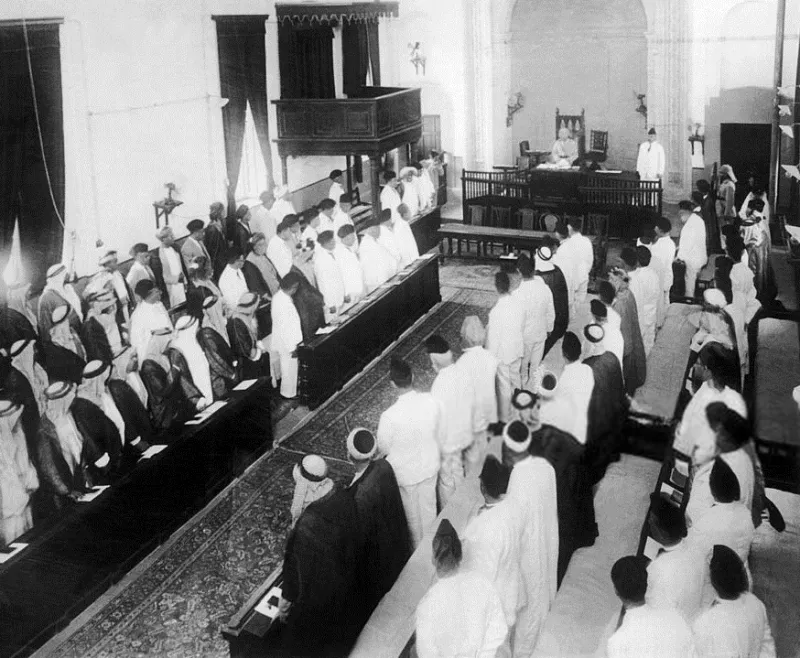
Photo: AnonymousUnknown author, Public domain, via Wikimedia Commons
In the months following any Iraqi parliamentary election, a peculiar ritual unfolds in Baghdad's fortified Green Zone. Politicians who spent the campaign season trading accusations of corruption and incompetence begin, with remarkable speed, to negotiate the terms of coalition government. These negotiations are rarely about policy platforms. They are, in essence, negotiations about price.
Ministries are assigned monetary values. Security portfolios command premium rates. Lesser agencies — education, health, culture — are distributed to satisfy smaller factions or to create the appearance of technocratic credibility. The resulting government is not a governing coalition in any conventional sense. It is a revenue-sharing arrangement dressed in the language of democratic pluralism.
The Architecture of Bought Loyalty
Iraq's muhasasa system — the sectarian-ethnic power-sharing formula institutionalized after 2003 — was designed, at least in theory, to ensure that no single community dominated the post-Saddam state. In practice, it created something quite different: a framework within which political elites from every community compete not for governing authority but for access to the state's financial flows.
Oil exports generate the overwhelming majority of Iraq's government revenue — typically above 90 percent in any given year. That revenue passes through the Finance Ministry and is then distributed across a budget process that, while nominally subject to parliamentary oversight, operates in practice as a negotiated division of spoils. Ministries become fiefdoms. Government contracts become the primary mechanism through which political leaders reward their networks and maintain the loyalty of subordinate figures.
The scale is difficult to overstate. Iraq's annual budget has in recent years exceeded $150 billion in approved spending. Independent economists and anti-corruption researchers estimate that the proportion lost to inflated contracts, ghost employees, and outright embezzlement ranges from 20 to 40 percent, depending on the sector. That represents, conservatively, tens of billions of dollars annually flowing not into services but into the maintenance of political loyalty networks.
Why Factions Stay at the Table
The logic that sustains this system is, from the perspective of its participants, coldly rational. Leaving the coalition — refusing to participate in government formation, mounting principled opposition — means forfeiting access to the resources that fund one's political organization, pay one's security apparatus, and maintain the patronage relationships that constitute one's political base.
Iraqi political parties, with very few exceptions, do not generate revenue through membership dues, small-dollar fundraising, or ideological constituency building. They are sustained by state access. A party that loses its ministry loses its income. A faction leader who cannot deliver government jobs and contracts to his community loses his community's loyalty. The incentive structure systematically punishes integrity and rewards participation.
This creates a peculiar dynamic in which political actors who are personally hostile — who may have armed wings that have killed each other's members — nonetheless find it rational to share a cabinet. The government is not a vehicle for governance. It is the mechanism through which Iraq's political class collectively manages its access to oil wealth.
External Powers and the Patronage Maze
For the United States, Iran, Turkey, Saudi Arabia, and other external actors seeking to exercise influence in Baghdad, the patronage system presents a fundamental challenge. Conventional diplomatic tools — pressure, incentives, public condemnation — operate on the assumption that political actors respond to reputational costs and policy-based incentives. In an environment where political survival depends entirely on maintaining internal loyalty networks funded by state resources, those assumptions frequently fail.
Washington has repeatedly discovered, to its frustration, that Iraqi politicians who express genuine alignment with American interests in private prove unable or unwilling to translate that alignment into policy. This is not always, or even primarily, a matter of deception. It is often a structural constraint. A faction leader who moves against the consensus of the patronage coalition risks losing the internal support that sustains his position. American approval cannot substitute for that support.
Iran has, in this respect, demonstrated a more sophisticated understanding of the system. Tehran's influence in Baghdad is not primarily ideological — though ideology plays a role — but financial and organizational. Iran-aligned factions have been integrated into Iraq's formal security structure through the Popular Mobilization Forces, giving them access to state salaries and budgets. That integration makes Iranian influence structurally embedded in the Iraqi state in ways that diplomatic pressure cannot easily dislodge.
The Reform Trap
Iraq has not lacked for reform initiatives. The post-2019 protest movement generated genuine political pressure for systemic change. Prime ministers from Mustafa al-Kadhimi to Mohammed Shia' al-Sudani have, at various points, announced anti-corruption campaigns and pledged to rationalize government spending. International financial institutions have conditioned assistance on structural reforms.
These efforts have produced limited results, and the reasons are structural rather than incidental. Genuine reform of the patronage system would require political actors to voluntarily dismantle the mechanism by which they sustain their own power. The collective action problem is essentially insoluble within the current political framework. Any faction that unilaterally withdrew from the patronage system would simply cede its position to competitors willing to continue playing by the existing rules.
The one force capable of disrupting this equilibrium — sustained, organized public pressure — has proven difficult to sustain. The Tishreen movement of 2019 demonstrated that Iraqi civil society can generate mass mobilization. It also demonstrated that the patronage system's beneficiaries are willing to use lethal force to defend their position, and that the movement's decentralized structure made it vulnerable to both repression and co-optation.
What Washington Must Reckon With
American policymakers approaching Iraq with democracy-promotion frameworks or governance reform agendas are, in a meaningful sense, proposing to a political class that it should voluntarily impoverish itself. The proposal is unlikely to succeed on its own terms.
A more effective approach would require engaging the patronage system not as an aberration to be corrected but as the actual operating logic of Iraqi politics. That means identifying the specific leverage points where external actors can alter the cost-benefit calculations of individual political figures, rather than appealing to systemic reform in the abstract. It means understanding which factions are most financially dependent on state access and therefore most vulnerable to targeted pressure, and which have diversified revenue streams — including militia-linked commercial enterprises — that make them effectively insulated.
Most fundamentally, it means accepting that Iraq's political order will not be reformed from the outside, and that the most productive American role is supporting the internal forces — civil society organizations, independent journalists, reform-oriented technocrats — who are attempting to alter the system's logic from within. That is a slower, less satisfying, and considerably more uncertain project than diplomatic engagement with Baghdad's established elite. It is also, by available evidence, the only approach with a realistic prospect of producing durable change.