Thirst as a Weapon: How Iraq's Water Crisis Is Quietly Redrawing Regional Power
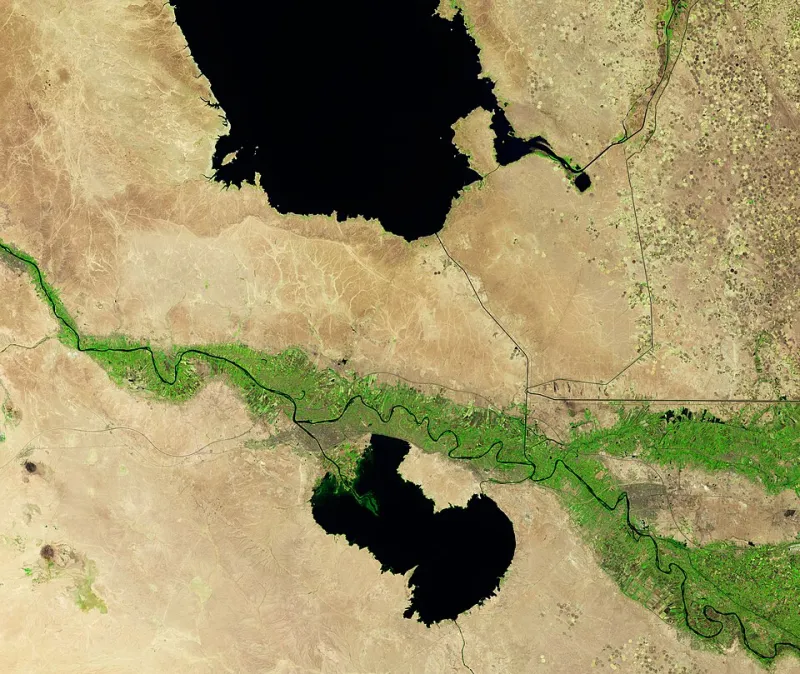
Photo: NASA Earth Observatory images by Michala Garrison, using Landsat data from the U.S. Geological Survey and water level data from Global Water Measurements. Story by Adam Voiland., Public domain, via Wikimedia Commons
For decades, the dominant language of Middle Eastern conflict has been oil — barrels, pipelines, sanctions, and extraction rights. But in Iraq today, a different resource is emerging as the more immediate, and perhaps more destabilizing, source of tension. Water, or rather the accelerating absence of it, is quietly reshaping the country's political geography, threatening the livelihoods of millions, and exposing the limits of an American foreign policy framework that has yet to reckon seriously with what resource scarcity can do to an already fragile state.
Iraq is not simply experiencing a dry spell. Hydrologists and regional analysts describe the current conditions as the worst sustained drought the country has faced in at least four decades. The Tigris and Euphrates rivers — the twin arteries of one of humanity's oldest civilizations — are flowing at a fraction of their historical volumes. In the southern provinces, marshlands that were partially restored following Saddam Hussein's deliberate drainage campaigns are again receding. Farmers in Diyala, Wasit, and Basra are abandoning fields that their families cultivated for generations. The land is not merely dry; in many areas, it is salinating, rendering recovery increasingly unlikely even if rainfall returns.
Upstream Power, Downstream Consequences
The crisis cannot be understood without confronting an uncomfortable geopolitical reality: Iraq has almost no control over the headwaters of its own rivers. Turkey, through its expansive Southeast Anatolia Project — known by its Turkish acronym, GAP — has constructed a cascade of dams on the upper Euphrates and Tigris that has dramatically reduced downstream flow into Iraqi territory. The Atatürk Dam alone, one of the largest in the world, has transformed the Euphrates into something closer to an irrigation channel than a river by the time it crosses the Syrian-Iraqi border.
Iran presents an equally consequential upstream threat, though one that receives even less attention in Western policy discussions. Tehran has systematically diverted tributaries that feed into eastern Iraq, including the Karkheh and Karun river systems. Several of these diversions have been conducted with minimal diplomatic notification, and Iraq's formal protests have produced little more than procedural acknowledgment. The result is that Iraq, a country already hobbled by institutional dysfunction and decades of conflict, finds itself hydraulically dependent on two neighbors — one a NATO ally and one a designated state sponsor of terrorism — neither of which has demonstrated meaningful willingness to subordinate its own development priorities to Iraqi survival.
The Human Arithmetic of Collapse
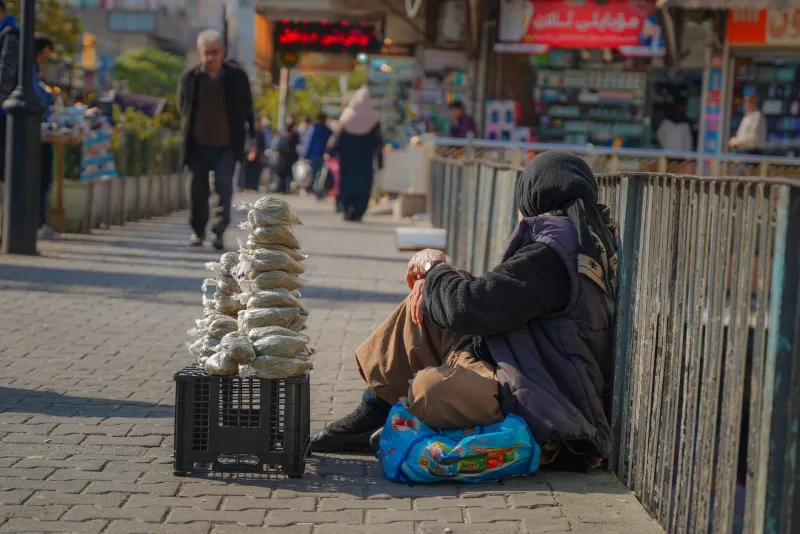
The abstraction of geopolitics becomes concrete in the villages of southern Iraq. Displacement driven by water scarcity is already occurring at a scale that analysts describe as a slow-motion humanitarian emergency. Families that once farmed rice and wheat along the Euphrates delta are relocating to already overburdened cities like Basra, Najaf, and Baghdad. This internal migration is compounding urban unemployment, straining municipal infrastructure, and feeding the grievance economy that has historically sustained militia recruitment.
For American policymakers, the relevant historical parallel may be Syria. The catastrophic drought that struck Syria between 2006 and 2011 contributed directly to the rural-to-urban displacement that preceded the uprising against Bashar al-Assad. That connection between climate stress and political instability was well-documented in academic literature but largely absent from the strategic assessments circulating in Washington before Syria's collapse. Iraq's trajectory contains uncomfortable echoes of that failure of foresight.
The numbers involved are not trivial. The United Nations Environment Programme has estimated that Iraq could lose up to seven million acres of arable land over the coming decades if current water-flow trends continue. The Food and Agriculture Organization has flagged Iraq as one of the countries most acutely vulnerable to food insecurity driven by water stress. These are not projections buried in technical appendices — they are warning signals that have been available to policymakers for years.
Washington's Blind Spot
American engagement with Iraq remains overwhelmingly organized around two preoccupations: counterterrorism and the management of Iranian influence. Both are legitimate concerns. Neither is sufficient as a framework for understanding what Iraq is becoming. The U.S. has invested billions of dollars in Iraqi security sector reform, in training programs, in political facilitation. It has invested comparatively little in the hydraulic infrastructure that determines whether Iraqi society remains viable at a basic material level.
The diplomatic dimension of this neglect is particularly striking. The United States maintains substantial leverage over Turkey through the NATO alliance. It has, at various points, used that leverage to pursue objectives ranging from basing rights to currency policy. There is no comparable record of sustained American pressure on Ankara regarding its management of shared water resources with Iraq. The GAP project has proceeded largely without meaningful American diplomatic friction, even as its downstream consequences for a country the U.S. has spent trillions attempting to stabilize become increasingly apparent.
With Iran, the diplomatic toolkit is admittedly more constrained. But even within the existing sanctions architecture, there are mechanisms through which Washington could elevate water diversion as a formal grievance in multilateral forums. It has not done so with any consistency.
The Regional Multiplication Effect
Iraq's water crisis does not exist in isolation. Jordan faces its own acute shortages. Syria's agricultural capacity remains severely diminished. The broader Fertile Crescent — the geographic cradle of settled agriculture — is under simultaneous stress from climate change and upstream extraction. What is emerging, in slow and largely unreported fashion, is a regional water deficit that will interact with existing ethnic, sectarian, and national fault lines in ways that are difficult to model but not difficult to anticipate in general terms.
For Iraq specifically, the political consequences of sustained agricultural collapse are not hypothetical. The country's southern Shia heartland — the geographic base of the most powerful militia networks and the electoral constituency that Iranian-aligned parties depend upon — is also the region most acutely exposed to water stress. There is a grim irony in the possibility that Iran's upstream diversions may ultimately erode the social stability of the Iraqi communities Tehran has spent decades cultivating as strategic assets.
A Policy Reckoning Overdue
Iraq Press has covered the manifold ways in which American policy toward Iraq has consistently prioritized the immediately urgent over the structurally important. The water crisis represents perhaps the clearest current example of that tendency. It is slower-moving than a militia attack and less photogenic than a bombing. It does not generate the kind of acute crisis that forces its way onto the agenda of a National Security Council meeting. But its cumulative effect on Iraqi state viability, on regional migration patterns, and on the conditions that produce political violence may ultimately prove more consequential than many of the crises that do command Washington's attention.
The rivers of Mesopotamia have sustained human civilization for roughly ten thousand years. Their diminishment is not a technical problem awaiting an engineering solution. It is a geopolitical emergency that requires diplomatic engagement at the highest levels, sustained investment in water infrastructure, and a fundamental rethinking of what stability in Iraq actually requires. The United States has a direct interest in that stability. Whether it has the strategic patience to pursue it through the unglamorous work of water diplomacy remains, for now, an open question.