The Exodus Calculus: Why Educated Iraqis Are Voting With Their Feet—and What It Costs Everyone Else
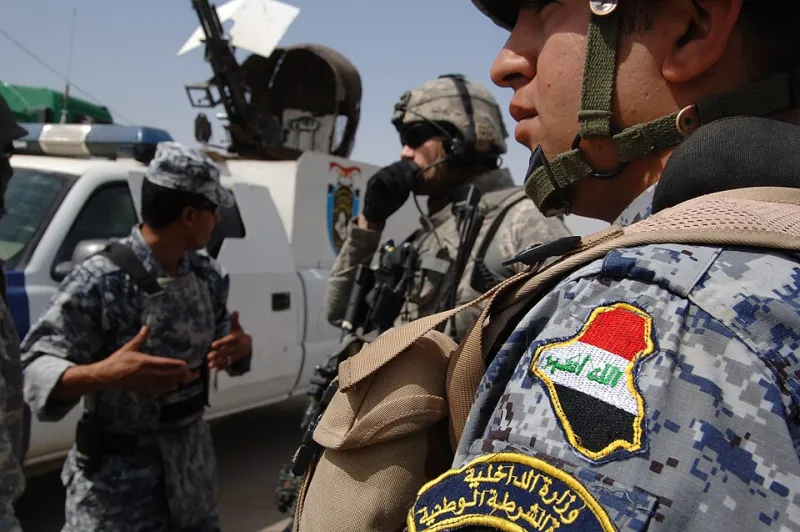
Photo: Sgt. 1st Class Gonzalo (John) Gonzalez, Public domain, via Wikimedia Commons
Consider the choice facing a 28-year-old Iraqi cardiologist who completed her residency at Baghdad Medical City last year. She has spent a decade in training, survived a university system gutted by decades of underinvestment, and emerged with credentials that would be competitive anywhere in the world. Now she must decide where to use them.
In Iraq, she can expect a public sector salary of roughly $800 a month, a hospital infrastructure so degraded that basic diagnostic equipment is frequently unavailable, and a professional environment in which advancement depends less on clinical excellence than on political connections and sectarian affiliation. She will work in a system where patients sometimes die from causes that would be entirely preventable in any adequately resourced facility. She will do this while navigating the security calculus that every professional in Iraq must perform daily.
In Germany, Canada, or the Gulf states, she can expect multiples of that salary, functional equipment, and a career trajectory determined primarily by merit. She will also be able to walk to her car at night without calculating risk.
This is not a difficult decision. And the fact that it is not difficult is, perhaps, the most damning indictment of the Iraqi state's failure to retain the human capital it desperately needs.
The Numbers Behind the Flight
Iraq has experienced waves of emigration throughout its modern history—the Jewish community's near-total departure in the early 1950s, the exodus of educated Iraqis during the Baathist period, the catastrophic sectarian displacement of 2006 and 2007. But the current wave has a character that distinguishes it from its predecessors: it is disproportionately concentrated among the young, the educated, and the professionally skilled, and it is happening not in the immediate aftermath of acute violence but during a period that Iraq's political class describes, with remarkable confidence, as post-conflict recovery.
The Iraqi Ministry of Migration and Displacement does not publish reliable emigration statistics—a lacuna that is itself revealing of state capacity. But data assembled from destination-country immigration records, Iraqi diaspora organizations, and independent research institutions paints a consistent picture. Estimates suggest that between 2019 and 2024, Iraq lost somewhere between 250,000 and 400,000 university-educated residents to permanent emigration. Among medical professionals specifically, the Iraqi Medical Association has reported that the country loses hundreds of trained physicians annually, with some years seeing departures that outpace new graduates entering the workforce.
For a country of approximately 42 million people with a healthcare system already operating far below minimum adequacy standards, these numbers are not merely concerning. They represent a structural deterioration that compounds with each passing year.
Rational Actors in an Irrational System
The dominant narrative in Western policy circles tends to frame Iraqi brain drain as a human interest story: talented individuals seeking better lives, understandably reluctant to sacrifice personal advancement for national obligation. This framing, while not inaccurate, misses the more important analytical point.
Iraq's educated class is not leaving because they lack patriotism or because they are uniquely susceptible to the allure of foreign comfort. They are leaving because they have correctly diagnosed the incentive structure of the Iraqi state and concluded that it cannot be reformed from within on any timeline that is relevant to their lives.
Consider what staying actually requires. An Iraqi engineer who chooses to build her career in Baghdad rather than Houston or Dubai must navigate a public sector hiring system in which technical qualifications are secondary to political sponsorship. She must compete in a private sector that is heavily distorted by the same political networks that control public contracting. She must operate in an environment where physical security is uncertain, where rule of law is inconsistently applied, and where her children will attend schools that are, by every available metric, dramatically inferior to what she could provide them abroad.
Asking her to accept these conditions in the name of national development is not a moral argument. It is a demand that she subsidize a dysfunctional system with her own professional life. The emigration decision is not a failure of individual commitment. It is a rational response to a correctly perceived reality.
The Compounding Cost
What makes brain drain uniquely devastating—as opposed to other forms of economic loss—is its self-reinforcing character. Each departure makes the conditions that prompted it slightly worse for those who remain.
When a senior physician emigrates, the junior doctors she was training lose a mentor. When a professor leaves for a European university, his graduate students lose a supervisor and the institution loses institutional knowledge that took years to accumulate. When a successful entrepreneur relocates her business to Amman or Dubai, she takes with her not just her own economic activity but the supply chain relationships, employment, and informal knowledge networks she had built.
This dynamic creates what development economists call a capability trap: the depletion of human capital makes institutional reform harder, which makes conditions worse, which accelerates further emigration, which depletes human capital further. Iraq is deep inside this trap, and the political class that might theoretically address it has, in many cases, already secured foreign residency for their own families as a hedge against the instability they help perpetuate.
What Reversal Would Actually Require
Diaspora engagement programs, return incentive packages, and bilateral agreements with destination countries are the standard policy responses to brain drain, and Iraq has experimented with versions of all of them. They have not worked, because they address symptoms rather than causes.
The professionals who have left Iraq are not unaware of their country's needs. Many maintain deep emotional and familial connections to Iraq and would, under different circumstances, consider return. What they will not do is return to a system that would waste their expertise, expose their families to preventable risk, and subordinate their professional judgment to political patrons who purchased their positions rather than earning them.
Reversal of Iraq's brain drain requires, at minimum, a credible demonstration that meritocracy is possible within Iraqi institutions—that a doctor can advance based on her clinical outcomes, that an engineer can win a contract based on the quality of his proposal, that an academic can publish research without political consequences. None of these conditions currently exist in any systematic way.
Until they do, the exodus calculus will continue to produce the same answer. And Iraq will continue losing, year by year, the very people without whom a different answer becomes impossible to reach.