Armed and Unaccountable: How Iraq's Privatized Security Landscape Became a State Within the State
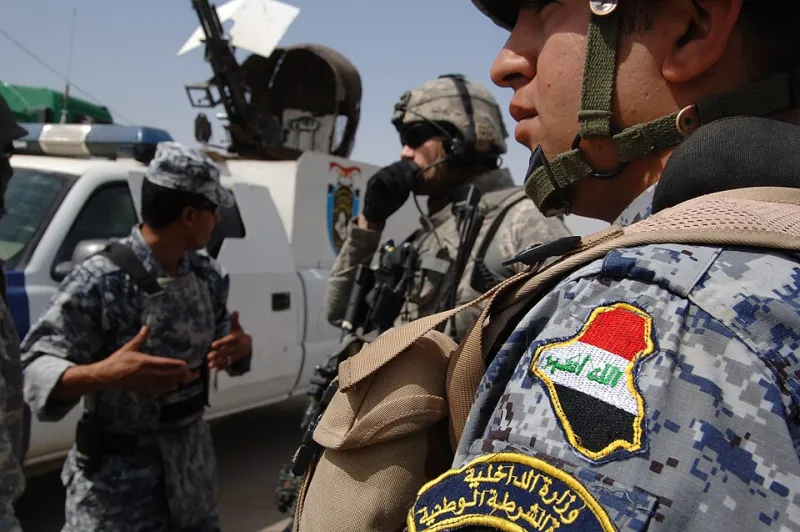
Photo: Staff Sgt. Brian Lehnhardt, Public domain, via Wikimedia Commons
The checkpoint appears without warning on a highway south of Baghdad—a strip of concrete barriers, a handful of armed men in mismatched uniforms, and a flag that belongs to no official Iraqi institution. Drivers slow, windows go down, and a brief, wordless negotiation takes place. Most pass without incident. Some pay. A few are turned back for reasons that are never articulated and never recorded.
This scene, repeated hundreds of times daily across Iraq, is not an anomaly. It is the operating norm of a country where the monopoly on legitimate force—the foundational requirement of any functioning state—has been comprehensively shattered and never convincingly rebuilt.
The Collapse of the Official Security Architecture
To understand how Iraq arrived at this point, it is necessary to revisit a decision made in the weeks following the 2003 U.S. invasion: the dissolution of the Iraqi Army by the Coalition Provisional Authority. That choice, widely regarded by American policymakers themselves as one of the most consequential errors of the post-invasion period, did not merely disband a military. It released hundreds of thousands of armed, trained, and now unemployed men into a society already fracturing along sectarian and regional lines.
The security forces that were subsequently built from scratch were never designed with institutional coherence as the primary objective. They were designed to satisfy competing political constituencies. Ministry of Interior positions were allocated by sect and party affiliation. Police commanders were chosen for their political reliability rather than their professional competence. Equipment procurement became a vehicle for kickbacks rather than genuine capability-building. The result was a force that, when tested by the Islamic State's 2014 offensive, collapsed with a speed that shocked even the most cynical observers.
The Islamic State's defeat did not restore that institutional coherence. It accelerated its further erosion. The militias that filled the vacuum left by collapsing army units—the Popular Mobilization Forces, formally incorporated into the Iraqi state but operationally answerable to their own leadership structures and, in many cases, to Tehran—emerged from the conflict with enormous prestige, expanded territorial presence, and deeply entrenched economic interests. Demobilizing them was never seriously attempted.
The Market for Protection
Into the space created by official security failure, a market has emerged. It is, like most markets, responsive to supply and demand—and the demand for reliable protection in Iraq is essentially unlimited.
At the neighborhood level, this market is supplied by what might diplomatically be called community protection networks and what more precisely resemble traditional protection rackets. Businesses in many Baghdad districts pay monthly fees to armed groups that bear no official insignia in exchange for assurances that their premises will not be robbed, their owners will not be kidnapped, and their disputes will be resolved—after a fashion. The alternative, which is to rely on the official police, is regarded by most Iraqi business owners as either ineffective or actively dangerous, given the well-documented involvement of police personnel in extortion and theft.
At the corporate level, the security market is supplied by a sprawling industry of private contractors, many of them staffed by former military and police personnel from multiple countries, including the United States. International oil companies operating in southern Iraq, telecommunications firms, and NGOs all maintain private security arrangements that are, in practical terms, more sophisticated and better resourced than anything the Iraqi state provides. These arrangements create their own complications: parallel command structures, undefined legal jurisdictions, and an incentive to keep official security capacity weak enough to ensure continued demand for private alternatives.
At the political level, the market is dominated by militia-affiliated entities that have formalized their protection operations into quasi-governmental structures. Several major Iraqi militias now operate border crossings, port facilities, and customs checkpoints—not as rogue actors, but as officially recognized components of the Iraqi state apparatus, drawing government salaries while answering to their own chains of command.
A De Facto Feudal Order
The cumulative effect of these overlapping arrangements is something that scholars of political development have begun describing as neo-feudalism: a system in which protection, justice, and economic opportunity are dispensed not by impersonal state institutions but by personal relationships with armed patrons. The lord of the manor has been replaced by the militia commander or the well-connected former general, but the underlying logic—submit, pay tribute, and receive protection; resist and face consequences—is structurally similar.
For ordinary Iraqis, this system is experienced as a constant negotiation between competing authorities, each of which demands deference and none of which provides comprehensive security. A Shia family in a Baghdad neighborhood controlled by one militia faction may find themselves effectively barred from seeking employment with a business whose owner is affiliated with a rival group. A Sunni merchant in Anbar may navigate relationships with tribal security forces, official police, and PMF-affiliated checkpoints simultaneously, paying informal taxes to each.
The psychological toll of this environment is difficult to quantify but impossible to overstate. Multiple surveys of Iraqi public opinion consistently show that security—not corruption, not unemployment, not Iranian influence—ranks as the population's primary daily concern. Not the security of the country as a whole, but the security of the street, the market, the school run.
What This Means for Washington
For American policymakers, Iraq's fragmented security landscape presents a strategic challenge that resists the standard toolkit of U.S. engagement. Military training programs designed to build capable official forces have repeatedly produced units that are subsequently subordinated to militia command structures or that dissolve under pressure. Security sector reform initiatives have been absorbed and neutralized by the same political networks they were intended to dismantle.
More fundamentally, the privatization of violence in Iraq directly threatens American interests by providing the operational infrastructure through which Iran-aligned groups project power, harass U.S. personnel, and enforce compliance on Iraqi political actors. The checkpoints, the protection networks, the customs operations—these are not peripheral features of the militia economy. They are its revenue base and its coercive mechanism.
Any serious American strategy for Iraq must grapple with this reality rather than paper over it with optimistic assessments of official security force capacity. The men at those unmarked checkpoints are not a temporary inconvenience on the road to a functioning Iraqi state. They are, for now, the state—and they have no interest in being replaced.