Glass and Grit: Why Baghdad's Construction Boom Isn't the Recovery Washington Thinks It Is
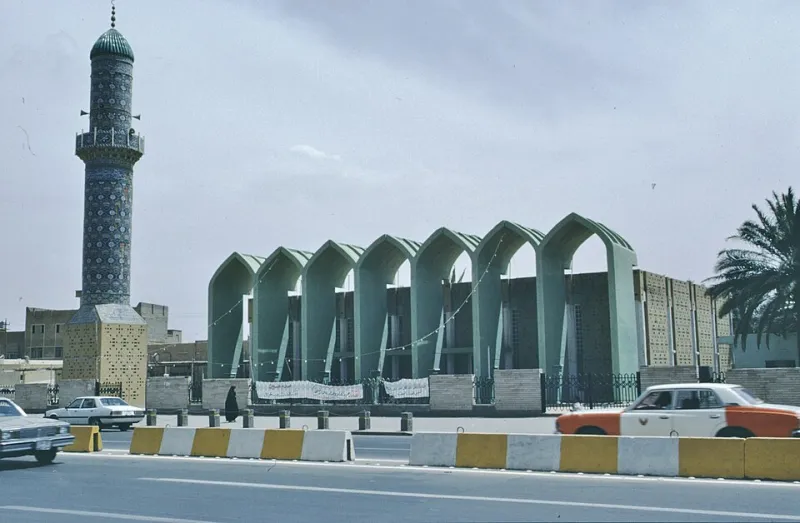
Photo: Karl Oppolzer, CC BY-SA 3.0, via Wikimedia Commons
Fly into Baghdad International Airport today and you could be forgiven for thinking Iraq has turned a corner. Glass-fronted malls glitter along the airport road. Mixed-use towers climb over the Karrada skyline. Real estate brokers speak of a construction boom, and a steady stream of trade delegations from Texas to Dubai arrives asking whether the moment to invest has arrived.
It hasn't. What visitors are seeing is not recovery. It is a symptom of the same old disease, wearing a new coat of paint.
The Oil-State Development Trap
Iraq's boom follows a template familiar to anyone who has studied petrostates. Venezuela in the Chávez years built gleaming plazas while its productive economy hollowed out. Nigeria's Lagos sprouts luxury towers amid chronic power shortages. The pattern is consistent: when a state's revenue comes from a single extractive commodity rather than taxation, its elite converts oil rents into visible, high-margin assets—malls, hotels, speculation—rather than into the boring, invisible foundations of a real economy: courts that enforce contracts, schools that produce engineers, grids that stay on.
Iraq fits the mold with unsettling precision. Roughly 90 percent of government revenue still comes from oil. The private sector remains a shadow, starved by a bloated public payroll that absorbs most of the state budget. The new towers rise because someone, somewhere, found a way to move oil money into concrete. They do not rise because the rules of doing business have changed.
The Misread That Keeps Repeating
American investors and policymakers have a weakness for façades. A mall with an international brand franchise reads, from Washington, as proof of a consumer economy. A hotel signing ceremony photographs well. But none of it touches the underlying arithmetic: an economy in which the state is the only real employer, in which banks exist to distribute government salaries rather than finance enterprise, and in which the ruling bargain—jobs for quiescence, contracts for loyalty—remains untouched.
Mistaking this for reform has consequences. It encourages US engagement strategies built on commercial diplomacy that benefits a narrow class of intermediaries, while the structural rot—corruption, dollar arbitrage, youth unemployment—deepens. Iraq's young entrepreneurs, some of the most resourceful in the region, continue to build in the informal economy precisely because the formal one is a gated compound.
What Real Change Would Look Like
If Washington wants signals worth acting on, it should ignore the skyline and watch for five things: a credible, independent central bank exchange-rate regime that kills the dollar-skimming racket; customs and tariff reform that ends the exemption economy; an actual census and tax base that binds citizens to the state; judicial enforcement of commercial contracts against politically connected firms; and a serious diversification agenda that survives a change of prime minister.
None of these will be announced at a ribbon-cutting. All of them would matter more than every mall on the Tigris combined. Baghdad's boomtown illusion will glitter for years yet. Americans should learn to look past the glass.